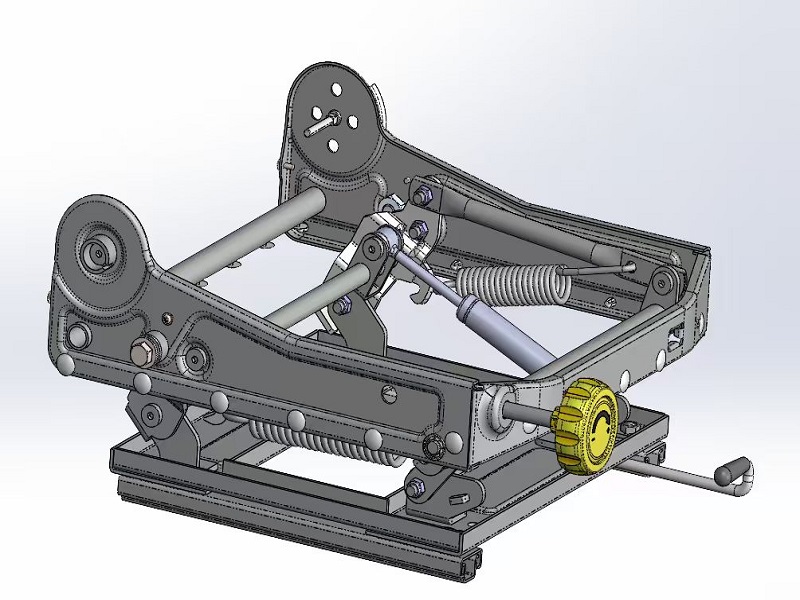
The core difference is in their fundamental technology for absorbing shock and vibration: mechanical seats use a system of springs and dampers, while air seats use a cushion of compressed air.
Here’s a detailed breakdown:
Mechanical Suspension Seats
These are the more traditional, purely mechanical systems.
- How They Work:They rely on a combination of coil or torsion springs to absorb energy and a hydraulic or pneumatic damper (shock absorber) to control the rebound and oscillation of the springs. The driver’s weight compresses the spring, and the damper prevents it from bouncing uncontrollably.
- Key Features:
- Weight Adjustment:Usually have a large mechanical dial or lever that pre-tensions the main spring to match the driver’s weight.
- Fixed Ride:Once set, the suspension has a fixed stroke and damping characteristic. It’s optimized for the weight it’s set for.
- Simplicity & Durability:Fewer complex parts, generally very robust and reliable with minimal maintenance.
- Cost:Significantly less expensive than air seats.
Air Suspension Seats
These are more advanced, using air pressure as the primary suspension medium.
- How They Work:They use an air spring (a rubber bellows) filled with compressed air from the vehicle’s system. A small, integrated air valve and damper assembly automatically adjusts the pressure in the bellows to maintain a pre-set ride height, regardless of the driver’s weight.
- Key Features:
- Automatic Weight Adjustment:You simply set your desired ride height (usually with an up/down switch). The seat automatically inflates or deflates the air spring to maintain that height, constantly self-adjusting. No manual weight setting is needed.
- Superior Isolation:Air is better at filtering out high-frequency, small-amplitude vibrations (buzzing, chatter) that transmit through the frame. This provides a more “floating” sensation.
- Adjustability:Often come with more advanced adjustments like independent lumbar support, seat tilt, and armrests.
- Cost:More expensive upfront and potentially more costly to repair.
Side-by-Side Comparison
| Feature | Mechanical Suspension Seat | Air Suspension Seat |
| Core Technology | Springs (coil/torsion) + Hydraulic Damper | Air Bellows + Pneumatic Valve/Damper |
| Weight Adjustment | Manual – Driver must set a dial/lever for their weight. | Automatic – Driver sets ride height; air pressure self-adjusts. |
| Ride Quality | Good at absorbing large bumps/jolts. Can transmit more high-frequency vibration. | Excellent at isolating both large bumps and high-frequency vibrations (“cab chatter”). Smoother, floating feel. |
| Complexity & Cost | Simpler, more robust, lower cost to buy and maintain. | More complex, higher cost upfront. Potential for air leaks or valve issues. |
| Durability | Very high. Fewer parts to fail. Can handle harsh environments well. | High, but the air system adds potential failure points (bellows, valves). |
| Ideal For | Applications where cost is a major factor, environments where simplicity is key, or where vibration isolation is less critical. | Long-haul trucking, premium equipment, and any application where driver comfort, fatigue reduction, and health (protecting the spine) are top priorities. |
Which One is Better?
- For Ultimate Comfort & Health:Air suspension seats are superior. They significantly reduce driver fatigue and long-term back injury risk by providing better isolation from all types of vibration. This is why they are standard in virtually all modern long-haul trucks.
- For Budget & Simplicity:Mechanical seats are a very effective, reliable, and cost-conscious choice. They provide a massive improvement over a solid, non-suspension seat and are perfectly suitable for many vocational trucks, agricultural equipment, or shorter-haul applications.
Analogy: Think of it like vehicle suspension:
- Mechanical Seat= A robust truck suspension with leaf springs and shocks. It handles the load and big bumps effectively.
- Air Seat= The air suspension in a luxury car or high-end coach. It provides a silky, isolated, and automatically leveling ride.
In summary: If your primary goal is maximum comfort and you’re spending long hours in the seat, air suspension is worth the investment. If you need a dependable, cost-effective upgrade from a basic seat, a mechanical suspension seat is an excellent choice.