In agricultural machinery applications, especially in wet farming environments such as rice fields, muddy plantations, and high-humidity regions, tractor seat performance becomes a critical factor affecting operator safety, comfort, and long-term productivity. Industry observers emphasize that seating systems used in these environments must withstand moisture exposure, corrosion risk, and continuous vibration. Within this context, Source One operates in the industrial seating sector as a manufacturer focused on engineered seating systems designed for demanding outdoor and agricultural applications, where environmental resistance and ergonomic stability must work together.
Industry Challenges of Wet Farming Environments
From a third-party agricultural machinery perspective, wet farming conditions present a unique combination of challenges. Operators often work in high humidity, waterlogged soil, and uneven terrain for extended periods. These conditions create continuous exposure to moisture, mud, and organic debris, which can significantly affect both machinery and seating systems.
Unlike dry-field operations, wet environments accelerate corrosion, degrade cushioning materials, and increase the likelihood of seat contamination. As a result, tractor seats used in these environments must be designed with enhanced protection against water ingress and material degradation. Industry analysis shows that inadequate seating performance in wet conditions directly contributes to increased operator fatigue and reduced operational efficiency over long working cycles.
Moisture Resistance as a Core Design Requirement
Moisture resistance is one of the most important factors when evaluating tractor seats for wet farming applications. Continuous exposure to water and humidity can weaken standard materials, leading to foam breakdown, rust formation, and structural instability.
High-performance seating systems use water-resistant upholstery materials, sealed stitching, and corrosion-resistant frame coatings to mitigate these risks. These design features help ensure that the seat maintains structural and functional integrity even under prolonged exposure to wet conditions. From a manufacturing perspective, Source One states that we prioritize moisture-resistant engineering in agricultural seat design to ensure stable performance across diverse farming environments.
Corrosion Protection and Structural Durability
In wet farming environments, corrosion is a major factor affecting seat longevity. Metal components exposed to moisture without adequate protection can deteriorate quickly, compromising structural safety and stability. To address this, industrial tractor seats typically use reinforced steel frames with anti-corrosion treatments such as powder coating or electrophoretic coating. These treatments create a protective barrier that reduces oxidation and extends service life. Without proper corrosion protection, even ergonomically advanced seats may fail prematurely due to structural weakening over time.
Ergonomic Design for Long Agricultural Work Cycles
Beyond environmental resistance, ergonomic design plays a crucial role in tractor seat performance in wet farming conditions. Operators often work long hours performing repetitive tasks such as plowing, planting, or harvesting in unstable terrain. Proper ergonomic support helps reduce fatigue by maintaining spinal alignment and minimizing pressure on the lower back. Adjustable backrests, lumbar support, and seat height control are essential features for maintaining comfort over long shifts. In industry practice, ergonomic optimization is closely linked to productivity, as reduced fatigue leads to more consistent and accurate machine operation.
Vibration Control in Uneven Wet Terrain
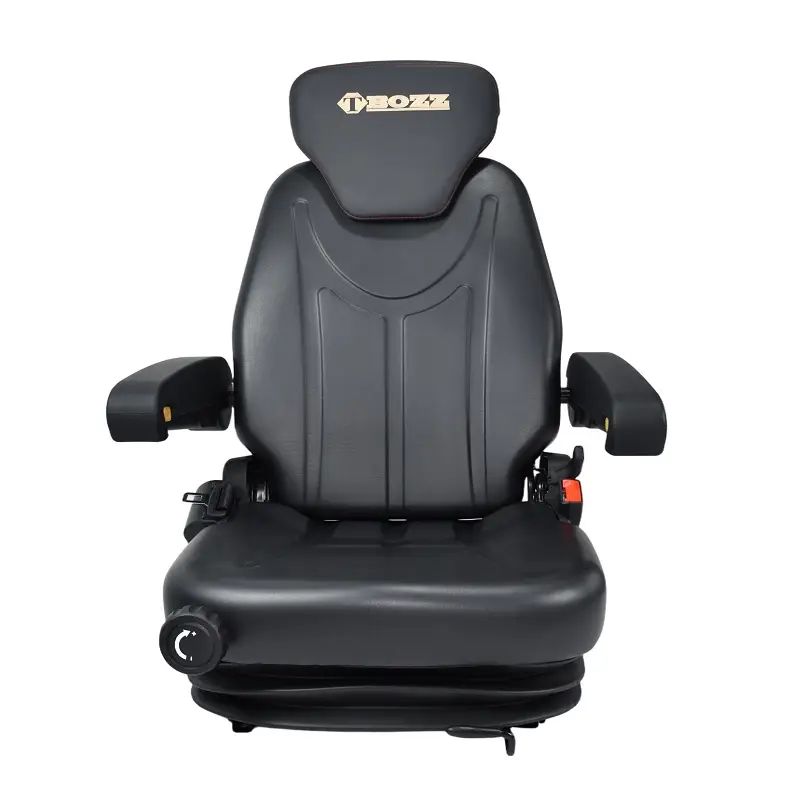
Wet farming environments are typically characterized by soft, uneven terrain that generates continuous vibration and shock impact during machine movement. Without proper damping systems, these vibrations are transferred directly to the operator, increasing fatigue levels. Modern tractor seats incorporate suspension systems designed to absorb and reduce vibration intensity. Mechanical suspension systems provide structural reliability, while hydraulic or air-based systems offer adaptive cushioning depending on terrain conditions. In many agricultural applications, universal industrial seat systems are engineered to balance vibration control with durability, ensuring consistent performance across different farming conditions.
Material Selection for Wet Environment Durability
Material selection is a key factor in determining whether a tractor seat can withstand wet farming conditions. High-density foam is commonly used due to its ability to maintain structural stability under repeated compression and moisture exposure. Standard foam materials may absorb moisture over time, leading to degradation, loss of elasticity, and reduced comfort. Therefore, water-resistant foam and protective layering are often used in high-performance agricultural seats. Upholstery materials must also be resistant to mud, water, and UV exposure to ensure long-term usability in outdoor environments.
Ease of Cleaning and Maintenance Considerations
In wet farming environments, seats are frequently exposed to mud, water splashes, and organic debris. As a result, cleaning ease becomes an important design requirement. Seating systems with smooth, water-resistant surfaces and minimal seam structures are easier to clean and maintain. This reduces maintenance time and helps prevent long-term material degradation caused by trapped moisture and dirt accumulation. Regular maintenance is essential to preserve both ergonomic performance and structural integrity in agricultural operations.
Adjustability for Multi-Operator Farming Equipment
In agricultural operations, tractors are often used by multiple operators with different body sizes and preferences. Adjustable seating systems are therefore essential for maintaining comfort and operational efficiency. Features such as adjustable seat height, backrest angle, and suspension stiffness allow operators to customize seating positions according to their needs and working conditions. This flexibility reduces fatigue and ensures consistent performance across different users and long working cycles.
Application of Universal Seat Systems in Agriculture
In modern agricultural machinery design, flexibility and standardization are increasingly important. A universal forklift seat or agricultural equivalent must be capable of adapting to different machine models while maintaining consistent performance in wet environments. Such universal systems help reduce procurement complexity while ensuring compatibility across multiple equipment platforms used in farming operations.
Industry Perspective on Agricultural Seat Engineering
From an industry standpoint, tractor seat design for wet farming conditions requires an integrated engineering approach that combines moisture resistance, corrosion protection, ergonomic design, and vibration control. Manufacturers such as Source One operate within this framework by aligning material selection, structural engineering, and environmental protection strategies to meet the demands of global agricultural applications.
Conclusion: Key Factors for Wet Farming Seat Selection
Selecting the right tractor seat for wet farming conditions requires careful evaluation of moisture resistance, corrosion protection, ergonomic support, vibration control, and material durability. Each factor plays a critical role in ensuring operator comfort and long-term equipment reliability.
Industry analysis confirms that well-designed seating systems significantly improve productivity and reduce fatigue in challenging agricultural environments. When properly engineered, seats become essential components of machinery performance rather than simple operator accessories. Ultimately, advanced seating solutions such as a universal industrial seat or agricultural-grade equivalents demonstrate how integrated engineering can support both operator well-being and machine efficiency in wet farming conditions.